2026 A Framework for Artificial Intelligence in Business Education V3 July 2026
 NEWLY UPDATED! The Graduate Business Curriculum Roundtable is pleased to support, in partnership with AACSB and the Graduate Management Admission Council (GMAC), the most recent report by Tawnya Means of Inspire Higher Ed - A Framework for Artificial Intelligence in Business Education: Exemplars and Critical Themes for Successful Integration.
With the latest report released in July 2026, A Framework for Artificial Intelligence in Business Education now includes analysis across 84 participating institutions.
This collaboration highlights institutional exemplars and effective practices while providing academic leaders and educators with a practical framework to guide their own AI journeys. AI has rapidly evolved from a promising innovation to a defining force in business education. Since the first edition of this framework in July 2025, the pace of change has intensified. What were once exploratory efforts are now strategic initiatives, with schools making deliberate decisions about curriculum design, faculty roles, infrastructure investment, and ethical responsibility. The January 2026 update featuring 48 institutions captured a pivotal transition, from experimentation to implementation. Now featuring 84 institutions, the latest version reflects not only increasing participation but also the accelerating pace at which business schools are embedding AI into their missions, strategies, and educational models. These reports offer timely insight for leaders navigating transformation amid ongoing uncertainty.
Confirming and expanding upon the Roundtable's latest curricular benchmarking report along with our Curricular Agility in Graduate Business Education survey report, the July report provides examples of how the transformation of business education through artificial intelligence has accelerated remarkably since the first iteration of this report in July 2025. What was then an inflection point has become an imperative. Business schools worldwide are actively determining how to integrate AI in their programs effectively, ethically, and at any scale. The pace of change has compressed what might have taken years into months, with institutions making decisive moves that reshape curriculum, pedagogy, faculty development, and institutional strategy.
Now covering 84 institutions, this latest report reflects both the increased interest in sharing approaches and recognition that collective learning accelerates individual progress. These schools represent the diverse landscape of business education: from elite research universities to regional teaching institutions, from large public systems serving tens of thousands of students to specialized private schools with intimate learning environments, and from domestic programs rooted in American higher education traditions to non-U.S. schools bringing global perspectives.
Key Developments (July 2026)
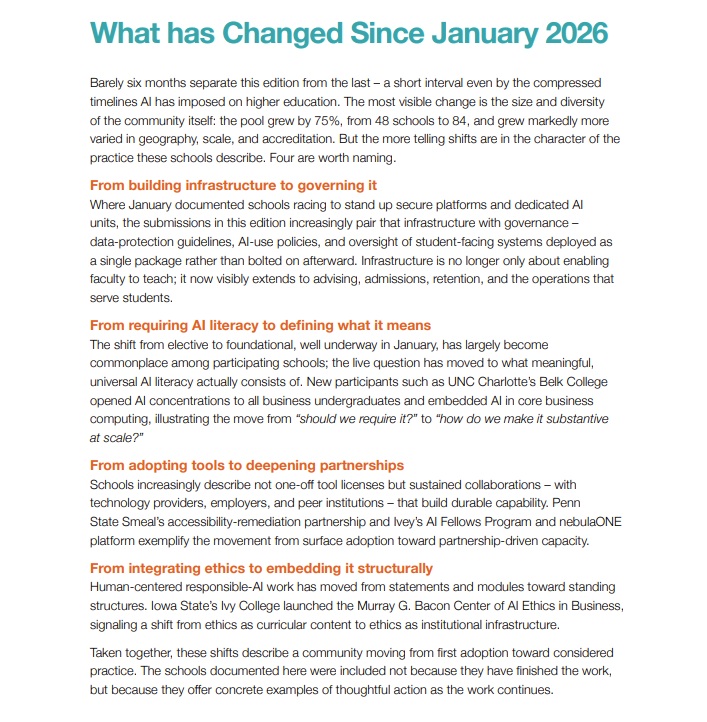
- From infrastructure to governance: Schools are pairing AI platforms with governance frameworks, policies, and oversight to support responsible AI use across teaching, student services, and institutional operations.
- From AI awareness to AI literacy: AI literacy is increasingly viewed as a foundational competency, with schools shifting their attention from whether to require it to how to embed meaningful AI capabilities throughout the curriculum.
- From technology adoption to strategic partnerships: Institutions are moving beyond individual AI tools toward sustained collaborations with technology providers, employers, and peer institutions to build long-term organizational capability.
- From teaching ethics to embedding responsible AI: Responsible AI is becoming part of institutional infrastructure through dedicated centers, governance structures, and integrated approaches that extend beyond standalone ethics instruction.
Eight Critical Themes Emerge from this report:

AI's role in the curriculum, both in what is being taught and in how it is being taught, is fast becoming one of the most critical strategic opportunities and challenges facing business schools and their leaders today. This report represents the Roundtable's commitment to supporting our members along with the graduate business industry in meeting those challenges successfully. The Roundtable is especially proud of the collaborative partnership that has supported this research and looks forward to future iterations and expansions of the report.
Click on the button below to request a copy of the latest report.

If you have any issues requesting a report download, please email: tawnya@inspirehighered.com.